Translate

Bag Filter

Bag Filter- It is used only low teperature application. The cleaned gas will goes through chimney to out and the dust will collect at the hopper

Cyclone

Cyclone- It is used for another types of dust cleaning from gas.

ESP

ESP- Electrostatic Precipitator

ESP

ESP-Electrostatic precipitator. it is most commonly used Dust cleaning machine from Gas. It is Used High temperature application .

Wet Scrubber

Wet Scrubbber- It is used in chemical factories to remove hazardes chemicals from the gas.

Showing posts with label Bag filter-Bag cleaning. Show all posts

Wednesday, July 22, 2015

Sonic

In a few systems, shaking is accomplished by sonic vibration (Figure 1). A sound generator is used to produce a low frequency sound that causes the bags to vibrate. The noise level produced by the generator is barely discernible outside the baghouse. Sonic cleaning is generally used along with one of the other cleaning techniques to help thoroughly clean dirty bags.
Fig. 1. Sonic vibrations, usually used
along with another bag
cleaning mechanism

Tuesday, July 21, 2015

Compartmentalized Pulse-Jet Baghouses

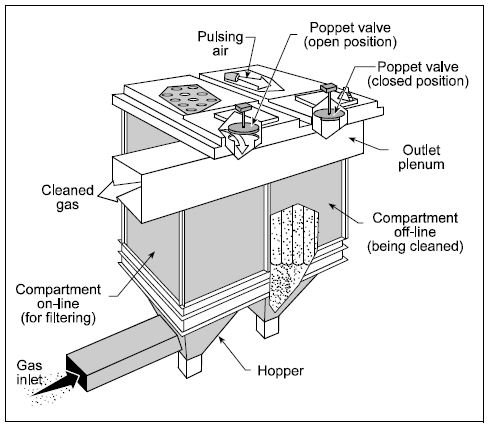
Pulse-jet baghouses can also be compartmentalized. In this case poppet valves located in the clean air plenum are used to stop the flow of dirty air into the compartment. Each compartment can be equipped either with a single pulse valve that supplies compressed air to the group of bags, or have separate pulsing valves that direct pulsing air into the blow pipes above the bag rows in the compartment. During the cleaning cycle the poppet valve closes, stopping the air flow through the compartment. The pulse valve opens for about 0.1 second, supplying a burst of air into the bags for cleaning. The compartment remains off-line for approximately 30 seconds, although this time period can be longer or shorter if desired. The poppet valve then automatically reopens, bringing the compartment back on stream. Alternate compartments are cleaned successively until all the bags in the baghouse have been cleaned (Figure 1). The cleaning cycle in each compartment lasts about 40 to 120 seconds. This cleaning is called off-line cleaning. It is frequently used on fabric filters installed on coal-fired boilers and municipal waste incinerators, allowing very thorough bag cleaning while the baghouse continuously achieves very low emission levels (less than 0.015 gr/dscf).
Fig. 1 Compartmentalized pulse-jet baghouse (plenum-pulse
baghouse)


Monday, July 20, 2015

Pulse Jet

The most commonly used cleaning method is the pulse-jet or pressure-jet cleaning. Baghouses using pulse-jet cleaning make up approximately 40 to 50% of the new baghouse installations in the U.S. today. The pulse-jet cleaning mechanism uses a high pressure jet of air (compressed air-induced pulse) to remove the dust from the bag. Bags in the baghouse compartment are supported internally by rings or metal cages. Bags are held firmly in place at the top by clasps and usually have an enclosed bottom (the bag is sewn closed at the bottom). In another design, a snap ring is sewn into the top of the bag which fits into the tube sheet opening. The cage slides inside the bag and the top of the cage sits on the tube sheet (see Figure 1). Dust-laden gas is filtered through the bag, depositing dust on the outside surface of the bag. Pulse-jet cleaning is used for cleaning bags in an exterior filtration system (See Figure 2).
Fig. 1. Snap-ring bag design for pulse-jet systems
Fig. 2. Typical pulse-jet baghouse with pulsing air supply

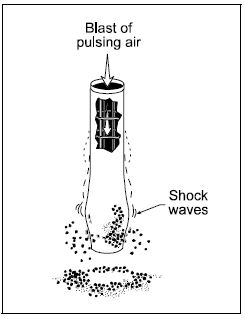
The dust is removed from the bag by a blast of compressed air injected into the top of the bag tube. The blast of high pressure air stops the normal flow of air through the bag filter. However, during pulse-jet cleaning, the flow of dirty air into the baghouse compartment is not stopped. The air blast develops into a standing or shock wave that causes the bag to flex or expand as the shock wave travels down the bag tube. As the bag flexes, the cake fractures, and deposited particles are discharged from the bag (Figure 3). The shock wave travels down and back up the tube in approximately 0.5 seconds.

Pulse-jet units are usually operated in a “non-dust cake” mode. Bags are pulsed frequently to prevent the formation of a thick cake and to keep the unit from having a high pressure drop across the dust cake and felted filter. However, sometimes a dust cake is desired in cases where woven bags are used in a pulse-jet baghouse.
Fig. 3. Pulse-jet cleaning

The blast of compressed air must be strong enough for the shock wave to travel the length of the bag and shatter or crack the dust cake. Pulse-jet units use air supplies from a common header which feeds pulsing air through a separate blow pipe located above each row of bags in a compartment. Pulsing air is directed into the bags through nozzles or orifices located on the blow pipe (Figure 4). A diaphragm valve on each blow pipe provides the very brief pulse of compressed air. The opening and closing of the diaphragm is controlled by an electrically operated solenoid valve.
Fig. 4. Pulse-jet cleaning system

In some baghouse designs, a venturi sealed at the top of each bag (see Figure 5) or just inside the top of each bag is used to create a large enough pulse to travel down and up the bag. Vendors using venturis in pulse-jet units claim that the venturis can help increase the cleaning pressure, and thereby improve bag cleaning. In other pulse-jet designs, venturis are not used, but the bags are still cleaned effectively. The importance of the venturis is debatable. The use of venturis has in some cases directed an increased air flow to a specific spot on the bag, and actually caused the bag to wear a hole very quickly. The critical factor to providing thorough bag cleaning is to make sure that the blow pipe and nozzle are properly aligned above the bag tubes.

Fig. 5. Venturis used with pulse-jet cleaning

The bag cleaning by the pulse occurs in approximately 0.3 to 0.5 seconds. The pressures involved are commonly between 60 and 100 psig (414 kPa and 689 kPa). Some vendors have developed systems to use a lower pressure pulsing air (40 psi). Most pulse-jet baghouses use bag tubes that are 4 to 6 in. (10.2 to 15.2 cm) in diameter. The length of the bag is usually around 10 to 12 ft (3.05 to 3.66 m), but can be as long as 20 ft (6.1 m). The shaker and reverse-air baghouses use larger bags than the pulse-jet units. The bags in shaker and reverse-air units are 6 to 18 in. (15.2 to 45.7 cm) in diameter and up to 40 ft (12.2 m) in length. Typical design parameters for pulse-jet cleaning are given in Table

                                                       Pulse-jet cleaning parameters


Saturday, July 18, 2015

Reverse Air

Reverse-air cleaning baghouses are compartmentalized to permit a section to be off-line for cleaning. In a reverse-air baghouse, the flow of dirty gas into the compartment is stopped and the compartment is backwashed with a low pressure flow of air. Dust is removed by merely allowing the bags to collapse, thus causing the dust cake to break and fall into the hopper. Cleaning air is supplied by a separate fan which is normally much smaller than the main system fan, since only one compartment is cleaned at a time (see Figure 1). The cleaning action is very gentle, allowing the use of less abrasion resistant fabrics such as fiberglass.
Fig.1 Typical reverse-air baghouse
During the filtering mode, the compartment’s outlet gas damper and inlet gas damper are both open. When bag cleaning begins, the outlet damper is closed to block the flow of gas. The bags are allowed to relax for a short time and the reverse air damper located at the top of the compartment is opened to bring reverse air for bag cleaning into the compartment. The reverse air flow usually lasts from about 30 seconds to as long as several minutes. During this time, dust falls into the hopper. Reverse-air baghouses also have by-pass dampers that allow the dirty gas to by-pass the compartments during malfunctions and start up periods.

In reverse-air baghouses, dust is collected on the inside of the bag. The bag is open at the bottom and sealed by a metal cap at the top (see Figure 2). Bags are connected to a tension spring that is attached to the frame located above to hold them in place. The tension spring allows the bags to move slightly during the cleaning process. The tension spring can be adjusted to make sure the bags do not sag too much, thus preventing the bags from creasing and eventually wearing out. The bottom of the bag fits over a thimble and the bag is attached snugly to the thimble by a clasp or clamp (see Figure 3).
Fig. 2. Bag attachment for reverse-air baghouses


The bag contains rings to keep it from completely collapsing during the cleaning cycle. Complete collapse of the bag would prevent the dust from falling into the hopper. Bags are supported by small steel rings sewn to the inside of the bag (see Figure 3). Rings are usually made of 3/16 inch carbon steel. Depending on flue gas conditions, they can also be composed of cadmium-plated galvanized, or stainless steel. The rings are placed every 2 to 4 feet apart throughout the bag length depending on the length and diameter of the bag. Usually, the spacing between anti-collapse rings is larger at the top of the bag and is smaller near the bottom of the bag. Reverse-air baghouses use very large bags (as compared to shaker or pulse-jet baghouses) ranging from 8 to 18 inches in diameter and from 20 to 40 feet in length.
Fig 3. Bag construction for a reverse-air baghouses

Reverse-air cleaning is generally used for cleaning woven fabrics. Cleaning frequency varies from 30 minutes to several hours, depending on the inlet dust concentration and the pressure drop of the baghouse. The cleaning duration is approximately 10 to 30 seconds; the total time is 1 to 2 minutes including time for valve opening and closing, and dust settling. Typical design parameters for reverse-air cleaning are given in Table

                                                     Reverse-air cleaning parameters


Thursday, July 16, 2015

Shaking

Shaking can be done manually but is usually performed mechanically in industrial-scale
baghouses. Small baghouses handling exhaust streams less than 500 cfm (14.2 m3/min)
are frequently cleaned by hand levers. However, thorough cleaning is rarely achieved
since a great amount of effort must be used for several minutes to remove dust cakes from
the bags. In addition, these small units do not usually have a manometer installed on them
to give pressure drop readings across the baghouse. These readings are used to determine
when bag cleaning is necessary. Therefore, manual shaker baghouses are not recommended
for use in controlling particulate emissions from industrial sources.
Mechanical shaking is accomplished by using a motor that drives a shaft to move a rod
connected to the bags. It is a low energy process that gently shakes the bags to remove
deposited particles. The shaking motion and speed depends on the vendor’s design and the
composition of dust deposited on the bag (see Figure 1). The shaking motion is generally
in the horizontal direction.

Fig.1. shaking

The tops of the bags in shaker baghouses are sealed or closed and supported by a hook or
clasp (see Figure 2). Bags are open at the bottom and attached to a cell plate. The bags
are shaken at the top by moving the frame where the bags are attached. This causes the
bags to ripple and release the dust. The flow of dirty gas is stopped during the cleaning
process. Therefore the baghouse must be compartmentalized to be usable on a continuous
basis. Shaker baghouses always use interior filtration (dust collected on the inside of the
bags).
Fig.2 Bag attachment for shaker cleaning baghouses
Fig 3. Typical shaker baghouse
In a typical shaker baghouse, bags are attached to a shaft that is driven by an externally
mounted motor (Figure 3). The bags are shaken, and the dust falls into a hopper located
below the bags. The duration of the cleaning cycle can last from 30 seconds to as long as a
few minutes, but generally lasts around 30 seconds.
Frequency of bag cleaning depends on the type of dust, the concentration, and the pressure
drop across the baghouse. The baghouse usually has two or more compartments to allow
one compartment to be shut down for cleaning.
Figure 4 shows a typical shaking mechanism of a shaker baghouse. The bags are
attached in sets of two rows to mounting frames across the width of the baghouse. A motor
drives the shaking lever, which in turn causes the frame to move and the bags to shake.
Fig. 4 Detail of a shaking lever system
Shaking should not be used when collecting sticky dusts. The force needed to remove
sticky dust can tear or rip the bag.
Bag wear can occur at the top of the bag where the support loop attaches; it can also be a
problem at the bottom of the bag where it is attached to the cell plate. Proper frequency of
bag cleaning is therefore important to prevent premature bag failure.
Typical design parameters for shaking cleaning are given in Table . Occasionally shaking
cleaning is used along with reverse-air cleaning to promote thorough bag cleaning for
applications such as coal-fired utility boilers.

                                                          Shaker cleaning parameters


Monday, July 13, 2015

Cleaning Sequences

Two basic sequences are used for bag cleaning: intermittent (or periodic) cleaning and continuous cleaning.

Intermittently cleaned baghouses consist of a number of compartments or sections. One compartment at a time is removed from service and cleaned on a regular rotational basis. The dirty gas stream is diverted from the compartment being cleaned to the other compartments in the baghouse, so it is not necessary to shut down the process. Occasionally, the baghouse is very small and consists of a single compartment. The flow of dirty air into these baghouses is stopped during bag cleaning. These small, single-compartment baghouses are used on batch processes that can be shut down for bag cleaning.

Continuously cleaned baghouses are fully automatic and can constantly remain on-line for filtering. The filtering process is momentarily interrupted by a blast of compressed air that cleans the bag, called pulse-jet cleaning. In continuous cleaning, a row of bags is always being cleaned somewhere in the baghouse. The advantage of continuous cleaning is that it is not necessary to take the baghouse or a compartment out of service for bag cleaning. Small continuously cleaned baghouses only have one compartment and are cleaned by pulse-jet cleaning described in detail later in this lesson. Large continuous cleaning baghouses are built with compartments to help prevent total baghouse shutdown for bag maintenance and failures to the compressed air cleaning system or hopper conveyers. This allows the operator to take one compartment off-line to perform necessary maintenance.